
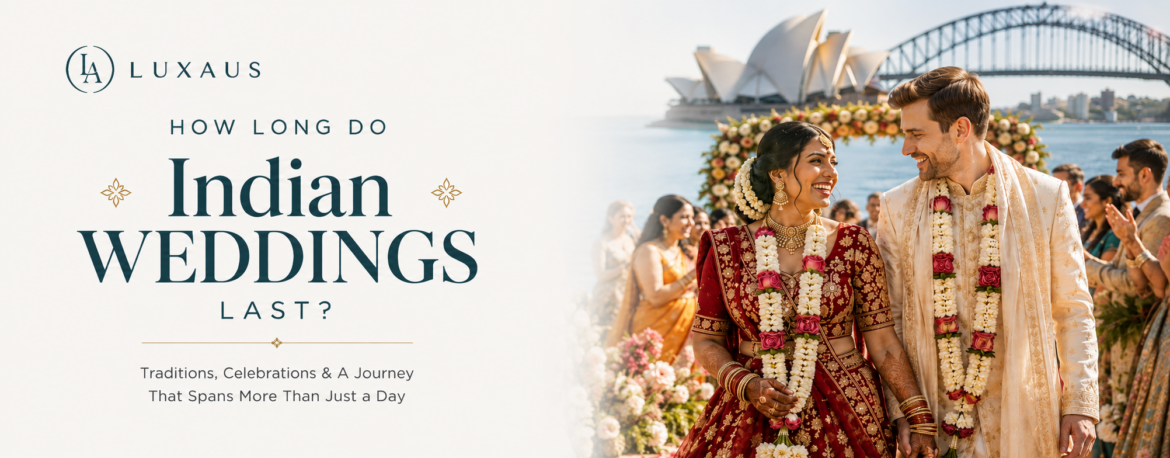
Planning an Indian wedding in Australia? Discover how long Indian celebrations last, what happens each day, a complete wedding timeline, and expert planning advice from LuxAus, Sydney’s leading multicultural wedding specialists.
How Long Does an Indian Wedding Last?
Traditionally, back in India, celebrations stretch between three and five days, and some regional customs can extend festivities to a full week.
For couples planning an Indian wedding Australia style, the absolute gold standard is a three-day celebration. This condensed timeline allows modern couples to fully honor sacred family rituals while seamlessly fitting into Australian venue hire blocks, managing weekend travel schedules for interstate guests, and navigating strict local municipal regulations.
Typical Indian Wedding Timeline in Australia
Indian wedding celebrations are incredibly vibrant and dynamic, often varying based on regional traditions, religious faiths, and family customs. While the timeline below outlines a typical multi-day flow, you can dive deep into the specific rituals, meanings, and structural breakdowns by checking out our comprehensive Hindu Ceremony Guideline Blog.
| Wedding Event | Typical Duration | Guest Count Target | Recommended Sydney Venue Strategy |
| Day 1: Mehendi & Haldi Ceremony | 3–5 hours | 50–150 guests | Intimate Settings: Home, boutique community halls, or private hire gardens in Western Sydney (e.g., Harris Park, Blacktown, or Dural). |
| Day 2: Sangeet or Garba Night | 4–6 hours | 150–300+ guests | Energetic Function Spaces: Purpose-built banquet spaces, or regional function centres with high-quality acoustic systems. |
| Day 3: Baraat, Ceremony & Reception | 12–14 hours total | 300–600+ guests | Grand Multi-Event Venues: Premium hotels or large-scale ballrooms capable of handling complex daytime/evening transitions. |
Why Are Indian Weddings Multi-Day Celebrations?
An Indian wedding ceremony rituals framework is much more than a single exchange of vows; it is a spiritual amalgamation of two families coming together. Each day focuses on distinct traditional milestones, requiring specialized setups and vendors. Depending on your direct heritage, your custom timeline may draw heavily from diverse cultural backgrounds:
Core Cultural Frameworks
- North Indian & Punjabi Traditions: High-energy Sangeet choreography, vibrant Jaggo nights, and the iconic Baraat drum-led procession.
- South Indian Wedding Traditions: Early morning Muhurtham timeframes, sacred Kanyadaanam, and deep Mangalya Dharanam blessings.
- Multicultural & Inter-Faith Fusion: Seamlessly merging distinct backgrounds, such as Hindu-Christian unions, Sikh-Hindu pairings, Muslim-Hindu celebrations, or beautiful Indian-Western fusion weddings.
Step-by-Step Multi-Day Planning Sequence
Pulling off a multi-event milestone in New South Wales requires strict chronological order. Booking your suppliers or venues out of order can lead to costly logistical errors.
- Confirm Your Muhurat and Cultural Style: 12–18 Months Before.
Before placing down venue deposits, consult your priest, celebrant, or family elders to officially confirm your Muhurat (auspicious wedding date and time window). This specific hour dictates whether you require an early morning layout—crucial for traditional south indian wedding setups—or an evening schedule.
- Secure a Culturally Capable Sydney Venue: 10–12 Months Before.
Not every premium Australian space can legally or structurally handle the requirements of an Indian wedding reception or traditional ceremony. Look for venues with a proven history of cultural flexibility. Ensure you ask about outdoor Baraat pathways, multi-day booking discount rates, and overnight decor change rules.
Planning Tip: Shortlisting locations that fulfill these complex requirements can be exhausting. To simplify your search, explore our verified insider review of the top Indian wedding venues in Sydney, highlighting the absolute best spaces for multi-day events.
- Assemble the Specialized Vendor Matrix: 8–10 Months Before.
A multi-day sprint requires specialized suppliers who understand South Asian workflows. Secure a dedicated Indian wedding decorators Sydney team capable of transforming empty spaces within tight deadlines. Hire your multi-event hair and makeup artists, a high-energy dhol player, and an experienced DJ who understands the perfect structural transition from traditional folk beats to modern reception dance tracks.
- Engineer Day Three ‘Flip Time’ Logistics:3–6 Months Before.
The final day is a massive 12-to-14-hour marathon. You must meticulously map out the transition period between the daytime ceremony conclusion and the evening doors opening. Always allocate a rigid 3 to 4-hour afternoon buffer. This gives your production crew time to reset the stage and allows your guests to head back, rest, and comfortably change into their glamorous formal wear.
Navigating the Practical Realities of Indian Weddings in Australia
To build real organic authority, you must look past generic overseas blogs and address the strict local legal compliance rules of New South Wales. Here is how we manage these hidden hurdles for our clients:
-
Fire and Rescue NSW Compliance Standards
The Havan or Agni (sacred fire) is a fundamental prerequisite for traditional Indian wedding traditions. However, real open flames indoors can instantly trigger building-wide automated isolation systems or fire department callouts.
The Solution: We work directly with leading venues such as the iconic Navarra Venues portfolio (Curzon Hall, Le Montage, Oatlands Estate) and The Highline Venue Bankstown coordinating with venue safety marshals to safely isolate specific smoke zones or utilizing pristine outdoor garden spaces.
-
Local Council Permits for the Baraat Procession
Bringing a grand groom’s procession to life with a mobile DJ truck, live dhol players, or a traditional white horse requires careful street management.
The Solution: Depending on your location, you may need traffic management permits filed months in advance with local authorities like the City of Parramatta, Liverpool City Council, or the Cumberland Council. We handle the complete municipal filing to prevent unexpected street-side shut downs.
-
Food Authenticity and the NSW Gold Licence Rule
Food is the ultimate metric of success for any South Asian gathering. Yet, many high-end Sydney hotels maintain exclusive in-house kitchen restrictions or demand that external culinary operations carry a valid NSW Gold Licence with comprehensive public liability insurance.
The Solution: LuxAus coordinates directly with elite, licensed indian wedding catering Sydney experts. This ensures your guests enjoy authentic, hot live chat stations and premium regional menus while fully complying with state food safety laws.
Key Takeaways for Indian Australian Couples
- Most traditional celebrations across Greater Sydney are optimized into a 3-day weekend block.
- Always lock in your auspicious Muhurat time before signing contract agreements with venues.
- A minimum afternoon gap of 3 to 4 hours is mandatory to successfully transition from the morning ceremony to the evening celebration.
- Working alongside an experienced multicultural wedding planner streamlines the complex task of managing multiple venues, strict council laws, and dozens of specialized suppliers.
Frequently Asked Questions (FAQ)
Can an Indian wedding be completed in just one day?
Yes, it is possible. Some modern couples combine their traditional ceremony and formal reception into a single, high-efficiency day to optimize budgets. However, most families still choose to host an intimate Mehendi or Haldi gathering at a private home a few days prior.
Most traditional ceremonies take between two and three hours to complete, depending on regional custom variants and specific familial elements.
Do all Sydney wedding venues allow external South Asian caterers?
No, many commercial properties enforce exclusive catering contracts. However, major multicultural celebration spaces across Greater Sydney welcome approved external suppliers who possess a verified NSW Gold Licence.
How long does a traditional Hindu wedding ceremony last?
The core Hindu wedding ceremony typically lasts between 1.5 to 3 hours, though the exact timeframe depends heavily on regional traditions and family customs:
- North Indian Ceremonies: Often take 2 to 3 hours, featuring an elaborate, high-energy Baraat (groom’s procession) and extensive rituals.
- South Indian Ceremonies: Tend to be highly concise and deeply spiritual, frequently taking between 30 to 60 minutes.
- Modern Condensed Timelines: Many contemporary Australian couples collaborate with their priest (Pandit) to streamline prayers, compressing the ceremony into an efficient 45 to 60-minute window.
Regardless of the regional style, the timeline is built around three foundational, time-honored rituals: the Kanyadaan (giving away of the bride), the Mangal Phera (circling the sacred fire), and the Saptapadi (the definitive seven steps that legally and spiritually seal the marriage).
LuxAus View: While the main religious ceremony takes only a few hours on Day Three, remember that the entire celebration spans a 3 to 5-day multi-day weekend block when you factor in the essential pre-wedding Mehendi, Haldi, and evening Sangeet festivities.
Why Experience Makes All the Difference
For more than 20 years, LuxAus has helped couples navigate the vibrant world of South Asian weddings across Australia. We understand that every family, region, and culture has distinct expectations. We don’t believe in rigid, cookie-cutter templates; we create customized multi-day itineraries that balance time-honored rituals with the realities of premium Australian venues.
We handle the council permits, the fire compliance paperwork, the vendor management, and the fine timeline scheduling so you can focus on enjoying every single moment of your celebration.